Request Demo

SOLUTION OVERVIEW

Healthcare CRM Software Built for Patient Access

Request a demo
SOLUTION OVERVIEW

The Reality without AI

Benefits of a Healthcare CRM

Create an exceptional patient experience by creating a beautiful staff experience.

Benefits of a Healthcare CRM

learn more

Streamline ALL of your processes

A beautiful and intuitive interface, powered by expert AI, guides your staff through their workflows, step-by-step, so that they can seamlessly help patients.
Streamline ALL of your processes

Better patient experience

Patient trust begins with a digital front door that lets patients complete their requests in real-time, anytime.

Better patient experience

Better team experience

Patients are overwhelmed when your staff is overwhelmed. Consolidate and standardize your workflows into a single tool. Improve employee morale and confidence.
Better team experience

Patient access functionality

Many of the above benefits come with additional products and modules. The core functionality, on its own, provides all the benefits you would expect in an advanced healthcare CRM system.
Request a demo
patient_access

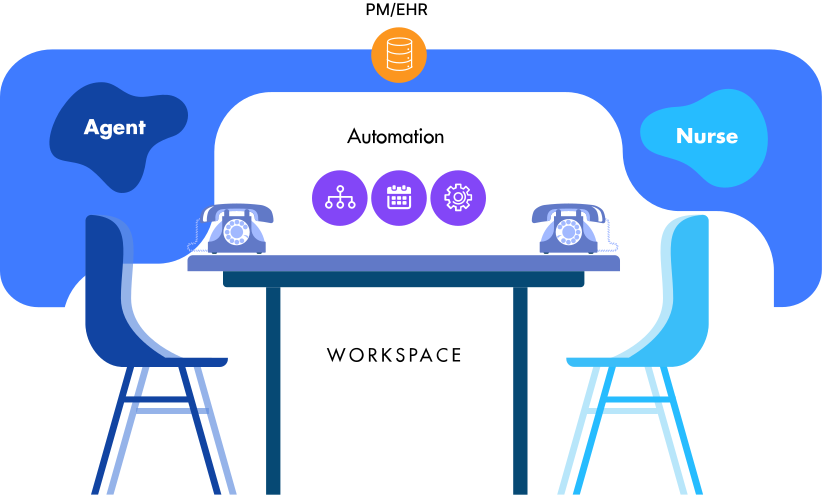
Agents & nurses can collaborate in a single workflow tool.

PM/EHR Workspace

· A one-page, digital workspace equips your team with everything they need to solve patient requests.
· The workspace automatically gives your staff all necessary data and integrations in real-time.

· The CRM gives your staff members scripts for all possible patient questions.
· Automated tools ensure efficiency and accuracy as your staff works.

Agent workspace provides complete patient context, service guidance, and task automation

Use a template or create a custom layout

Specify your workflow and automate decisions

No need to switch screens or make patients repeat information

This same logic lets patients answer any questions they have themselves while they’re still connected to the nurse and agent.

Automation that helps your agents also helps your patients.
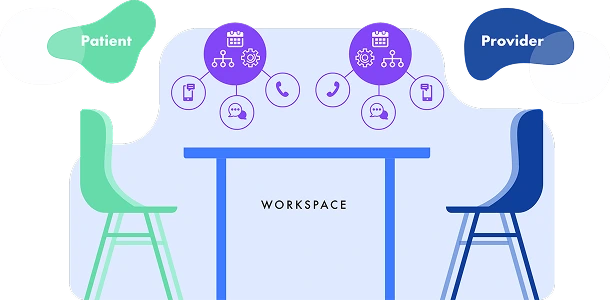
Workspace

Knowledge Management Auto-display on context, search when needed, send to patients

Decision support Scheduling, Symptom Screening, Nurse Triage

Self-service workspace Patient workspace, provider workspace, automate decisions, provisioning and communication

Process Queues Customize queues, custom automation

Omnichannel access Phone, web, mobile, chat

Reporting Report on all actions taken, all communications made, performance reports, syndromic surveillance, scheduling stats
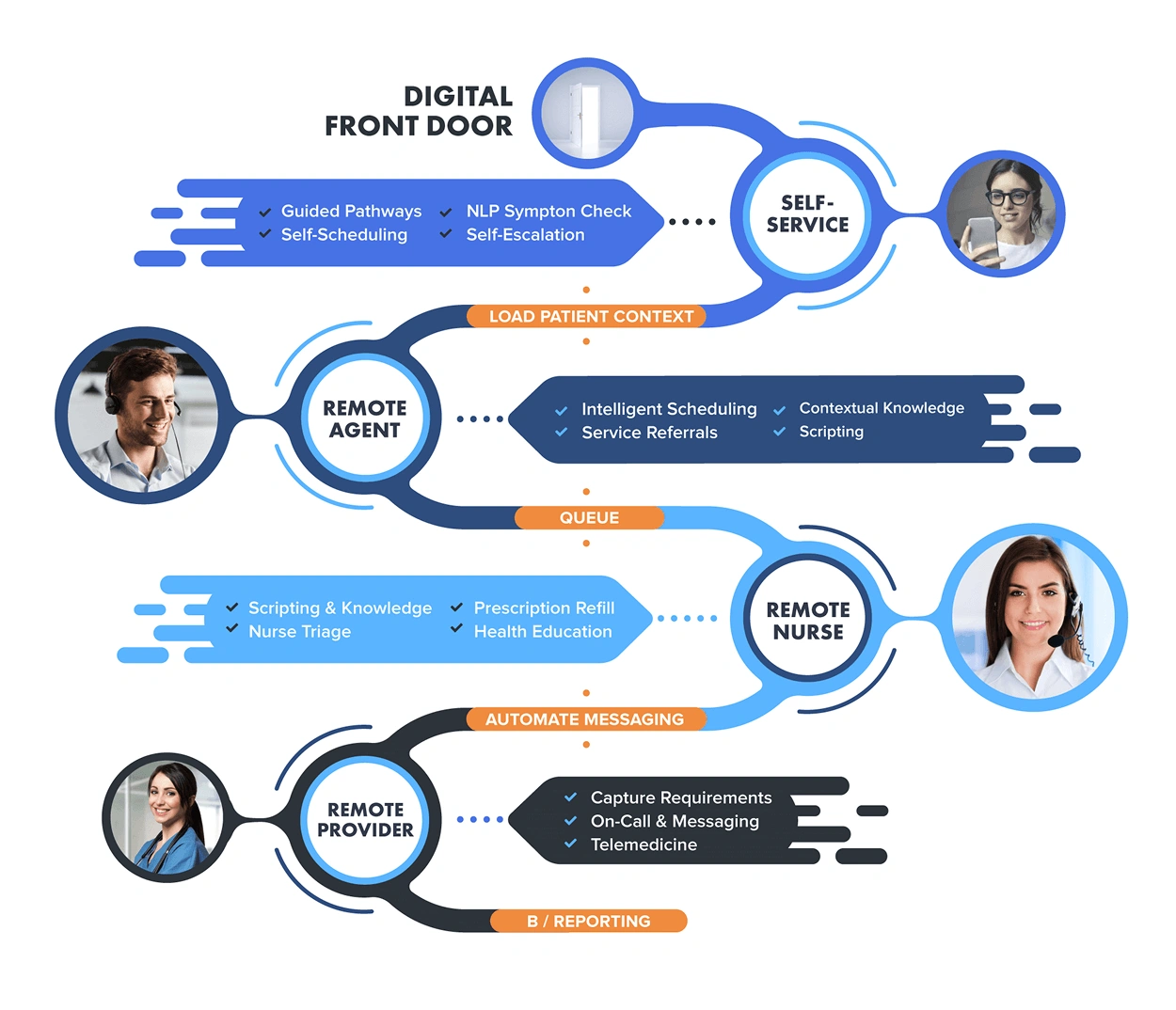
The result is an incredibly robust patient experience that will drive your digital transformation:

Digital Infrographics

Elevate both your staff & patient experience with AI-guided workflow management.

1

Consolidate

Bring disparate processes together into a one-page flow.

2

Standardize

Remove bottlenecks with data & systems integration.

3

Access

Open the workflow to patients.

4

Automate

Accelerate through automated decisions, actions, communication, and documentation.

5

Optimize

Monitor end-to-end performance and adapt to new use cases.

Patient Experience In A Digital Age

The future of patient experience.

Ultimate Guide to Telehealth

Patient Service Maturity Model

5 Steps to Telehealth Digital Transformation

Benefits of a Healthcare CRM

This same logic lets patients answer any questions they have themselves while they’re still connected to the nurse and agent.

Automation that helps your agents also helps your patients.

FAQ

1. What is CareDesk and how does it help patients?

CareDesk is Keona’s AI-driven healthcare CRM that automates patient access and telehealth services. It centralizes workflows across channels (phone, web, chat), reducing repetitive intake and streamlining navigation through scripts, triage, scheduling, and messaging all in one interface.

It supports omnichannel access: phone, web, mobile, and chat. Whether a patient calls, texts, or schedules online, they’re guided through a consistent, AI-assisted workflow.

1. AI-driven workflows:
2. Autopopulate patient context in real time
3. Guide agents with scripts and decision logic
4. Enable intelligent symptom screening and triage
5. Support automated scheduling, reminders, and follow-up messaging

No, information is captured once and passed through shared workflows. Both patients and staff avoid repeating data as the platform preloads history and request context.

It integrates intelligent scheduling logic to ensure 100% appointment matching, with no overbooking or provider mismatch, whether through self-service or agent scheduling.

Built-in symptom checkers and triage protocols guide patients and non-clinical staff to appropriate care options, ensuring safety and routing urgent cases properly.

Yes, an AI-driven platform can automate self-scheduling, waitlist joins, rescheduling, reminders, and calendar invites, giving patients seamless control over their care journey.

By sending automated personalized messages (via SMS, email, app) for appointments, education, bill/pay reminders, and surveys, improving engagement and compliance.

Yes, it connects with 40+ systems, including EHRs and practice management platforms, enabling real-time data sharing and unified patient records.

  • Up to 40% reduction in call center operational costs
  • 25%+ improvement in revenue through better engagement
  • 30% faster agent handling and 70% less training time
  • Increased patient satisfaction and retention

A healthcare CRM is patient relationship management software built specifically for clinical, scheduling, and contact center workflows. Unlike a generic CRM, a healthcare CRM is HIPAA-eligible, integrates bi-directionally with EHR and PM systems, supports clinical protocols like Schmitt-Thompson triage, and tracks healthcare-specific outcomes such as first-contact resolution and conversion to appointment.

The best healthcare CRM depends on the use case. Salesforce Health Cloud leads for enterprise marketing-led organizations. HubSpot is a strong fit for marketing automation in smaller practices. Keona's CareDesk is built specifically for patient access, nurse triage, and contact center workflows where the system needs to finish the patient request, not just track it. ServiceNow Healthcare and Microsoft Dynamics 365 Healthcare are the choices for large IDNs already standardized on those platforms.

An EHR stores the chart and supports clinical documentation. A healthcare CRM manages every patient interaction outside the chart: scheduling, contact center calls, nurse triage, web requests, after-hours coverage, marketing communications, and patient engagement. The two systems are complementary. Modern healthcare CRMs integrate bi-directionally with EHRs so the chart stays current without double entry.

Yes. The leading healthcare CRMs publish certified or productized integrations with all four major EHRs. Keona's CareDesk integrates with Epic, Cerner (Oracle Health), NextGen, Athena, eClinicalWorks, Allscripts, and Greenway Health. Integration depth varies by vendor: read-only data pulls are common, but bi-directional write-back to schedules and clinical notes is the higher bar to verify during procurement.

Healthcare CRM pricing typically runs from $50 per user per month for marketing-focused platforms to $300+ per user per month for full patient-access and clinical platforms with EHR integration and nurse triage. Implementation costs add 1-3x year-one license cost. Total cost of ownership over 3 years tends to land between $150,000 for a 50-user practice and $2M+ for a 500-user health system. Always price the integration and customization separately from the seats.

SEE HOW AI AUTOMATES PATIENT ACCESS

Discover the Power of CareDesk

Streamline workflows and cut overhead with CareDesk’s intelligent healthcare CRM.