Kara answers every patient call and completes repetitive requests. It is built on CareDesk, the healthcare CRM used by practices and health systems. Hard cases go to your staff with full context.
Patient demand isn’t uniform. It surges, and when it does, patient access breaks first.
Mornings. Mondays. Seasonal peaks.
Calls queue, patients hang up. Your staff moves faster, but accuracy drops and frustration builds for both patients and your team.
Handling patient demand shouldn’t have to depend on how quickly your team can react under pressure. With the right AI voice agent in place, it doesn’t.
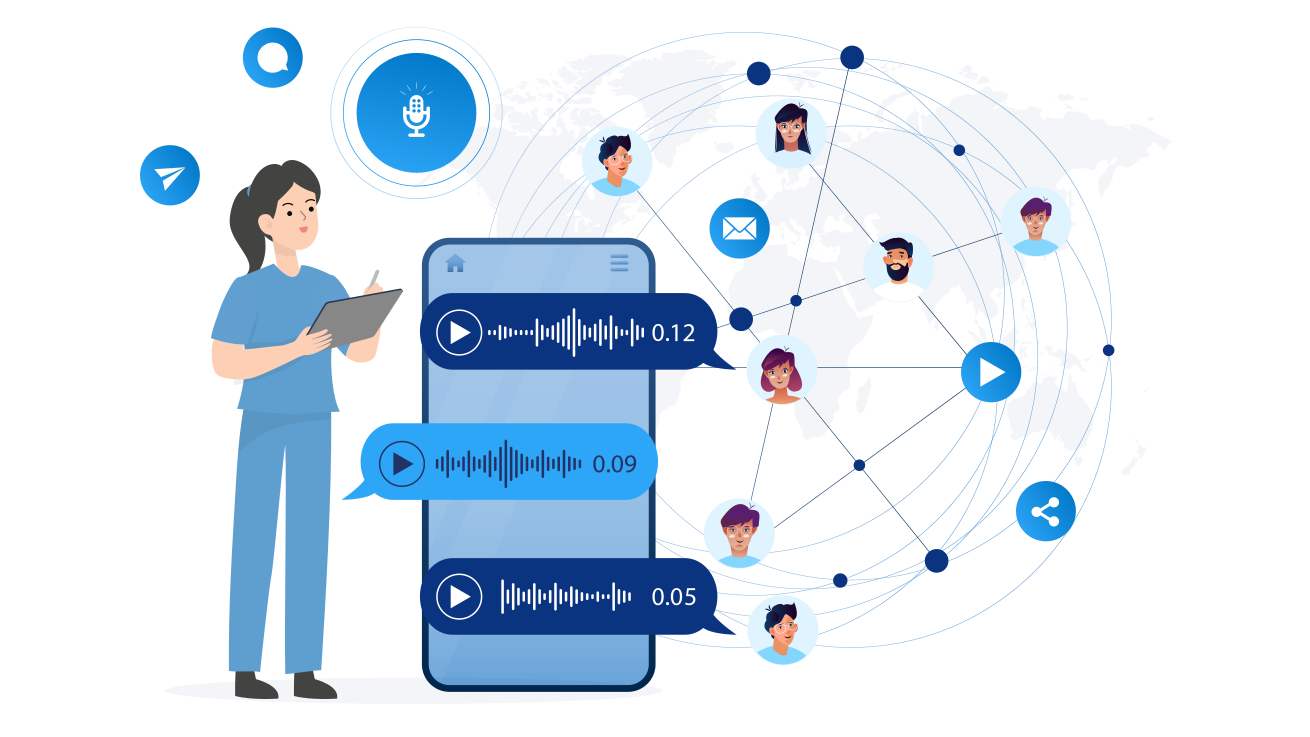

Answering every patient call immediately, without increasing your headcount or callbacks.
Completing repetitive requests end-to-end without pulling your staff away from more complex work.
For most healthcare organizations, this level of responsiveness feels out of reach. Access is constrained by staffing, and staffing has limits.
Most call handling systems treat every request the same.
In reality, patient access is shaped by a mix of volume, variability, and context.
Your call demand fluctuates throughout the day and week, but your staffing levels stay fixed.
Simple patient requests and complex coordination enter the same queue, competing for your team’s attention.
Your staff moves between systems to understand the patient, the provider, and the request before taking action.
Standard AI voice agent systems either fully automate or fully escalate. When a request falls outside your predefined paths, it breaks.
Add these together, and the outcome is predictable. Your queues grow, your calls are abandoned, and your staff spend time on work that doesn’t require their expertise.
Kara is built on CareDesk, a healthcare CRM shaped by over a decade of real-world workflows. It works by separating repetitive work from complex work, then handling each in the most efficient way possible.
01
Dual-Engine Architecture
Kara uses a dual-engine model designed for healthcare environments. The Autopilot engine completes your repetitive requests end-to-end. The Copilot engine supports your staff when cases require human judgment. When calls become complex, they transition instead of failing.
02
Autopilot: Repetitive Requests, Fully Handled
Common patient requests are completed without staff involvement:
Each interaction follows your practice workflows, so outcomes stay consistent regardless of your call volume.
03
Copilot: Complex Cases, Resolved Faster
When a request requires coordination or judgment, Kara escalates it to your staff with context already assembled:
Your staff step into the conversation with the relevant information in front of them, reducing repetition and shortening resolution time.
04
Practice Intelligence 360
Both engines operate using a shared context layer designed specifically for healthcare.
Patient 360: Your patients’ history, prior interactions, and relevant context for the individual patient.
Provider 360: Your providers’ preferences, scheduling constraints, and clinical workflows.
Practice 360: Your practice’s operational rules, protocols, and site-specific requirements.
Decisions are made with full context, not partial information.
05
Workflow Impact
Repetitive work is removed from your staff queues. Complex work becomes easier to resolve because the groundwork is already done. Patient access improves without increasing your staff levels, and your team can focus their time where it adds the most value.
Kara is live and answering calls in medical practices and healthcare systems today, with more expanding every month. For organizations evaluating what this approach can deliver at scale, CareDesk’s proven performance provides a clear reference point:
Kara ships new capabilities regularly, see our release notes for the latest.
These outcomes reflect what happens when AI voice is built on structured, context-driven systems.
Explore real-world examples:
Getting started follows a structured path designed around your existing workflows.
Map your highest-volume call types and simulate how they are handled using your practice’s rules.
Step 1Estimate Kara’s impact on your practice based on your call volume, abandonment rates, and visit revenue.
Step 2Launch your focused pilot, typically within 4 to 6 weeks, with measurable results within the first 60 days.
Step 3Healthcare organizations that implement healthcare-native AI voice technology are managing increased patient call volume without hiring more staff.
Find out why Kara, built on CareDesk, is more than an AI voice agent.
Our team can help you model the care completion, scheduling accuracy, and workflow impact that Kara can have for your organization.