You're on a call with a patient describing chest pain. Is it serious? Should they come in?
The quality of telephone triage a patient receives often varies by shift and tenure of the nurse answering the phone. Health systems implementing AI-supported and structured nurse triage can reduce that variability with consistent protocol adherence across teams.
That gap may look small on paper. In practice, it represents under-triage risk, over-triage cost, and documented variability in clinical decision-making.
The difference is not nurse capability.
It’s the workflow.
CareDesk gives you evidence-based answers in 30 seconds.

Delivering consistent, expert-level triage decisions on every call regardless of which staff member answers the phone.
Not dependent on tenure.
Not dependent on tenure.
Not dependent on tenure.
For most organizations, this level of uniformity feels out of reach. It implies scaling clinical judgment itself and not just staffing levels or scripts.
Clinical decision-making in telephone triage is not linear. It requires synthesizing context, evaluating multiple interacting variables, and determining the appropriate level of care based on those interactions.
Linear triage software
Static scripts for each isolated symptom.
Evaluates symptoms independently.
Provides the same recommendation in every situation.
Standardizes language only.
Clinical reality
Dynamic adjustment needed based on age, medications, pregnancy status and comorbidities.
Interaction between co-presenting symptoms changes risk and triage status.
The right decision depends on full context, location, time, staffing, and available resources.
Also needs consistent escalation decisions, documentation, and clinical reasoning.
CareDesk was not built to standardize scripts. It was built to scale clinical reasoning on patient calls, on the same healthcare CRM platform that runs the rest of your patient access.
At its core, this nurse triage software applies deterministic, evidence-based logic to every triage call to synthesizing patient context, clinical protocols, and operational realities in real time.

01
Context Before Conclusion
Consolidates critical information instantly: medical history, medications, allergies, recent encounters, and prior triage documentation. Telephone triage nurses can focus on clinical interpretation rather than information retrieval.
02
Protocols adapt to the patient
Schmitt-Thompson and other evidence-based protocols dynamically adapt based on age, comorbidities, medications, and clinic triage SOPs.
03
Risk flags automatically
When risk thresholds are met, the appropriate level of escalation is flagged: on-call physician call, home care, urgent follow-up, or ER referral.
04
Structured Documentation by Design
Every triage decision generates structured documentation that is aligned with the clinical reasoning pathway, strengthening defensibility.
05
Scalable consistency
The result is nurse triage services that deliver consistent care advice across shifts, locations, and experience levels. All with a solution that offers visibility into protocol adherence and performance pattern
Results from CareDesk Nurse Triage clients:
50%
Reduces nurse workload by 50%
70%
Reduction in onboarding time
2.5 days
To onboard new staff, versus the practice's own prior two weeks (Golden State Orthopedics & Spine)
34%
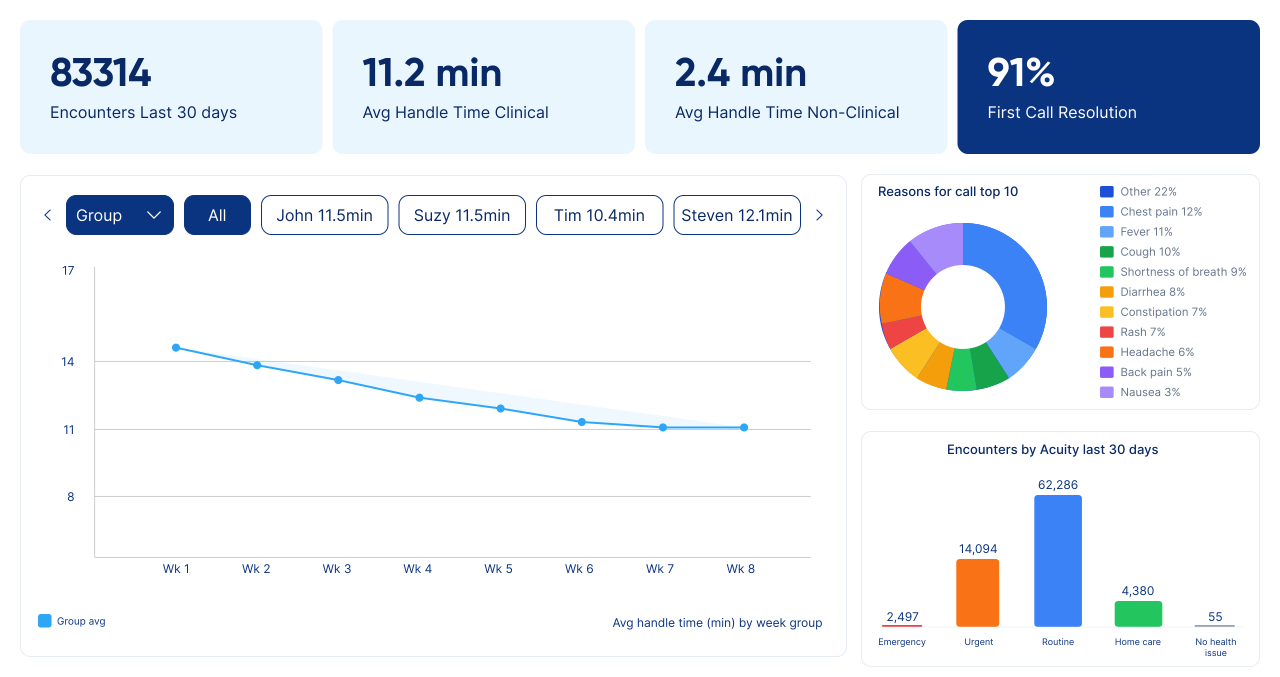
Advocate's clinical contact center cut mean handle time by 34% within four months of go-live (Advocate is a former client)
"I finally feel like I have a reliable partner who never gets tired."
PRN
Call Center Lead
Health centers and hospitals implementing structured nurse triage infrastructure are achieving gains in accuracy, consistency, and operational efficiency.
Others are spending the next 18 months catching up.
Our team can help you model the completion, accuracy, and workload impact CareDesk Triage can have for your organization now.