
Request Demo

Reduce Onboarding Time and Ramp New Healthcare Call Center Hires Faster with CareDesk 

Real-world examples show how CareDesk compresses training and helps new call center agents become productive sooner. Based on published case studies from current clients.

It’s a common situation in nearly all healthcare call centers and practices. New hires can take several months to become familiar with the systems they’re working and confident on live patient calls. This creates a measurable productivity gap. However, with CareDesk, health organizations are compressing this training period, which reduces onboarding time and increases the productivity of new hires. New team members get up to speed faster and are helping patients sooner. 

The examples below are verified outcomes from clients including Golden State Ortho (GSO), Virginia Women’s Center (VWC), Central Maine Healthcare, and EmergeOrtho- demonstrating measurable improvements in staff productivity across front-desk, nurse triage, and multi-region call center environments. EmergeOrtho BlueRidge is included separately as an early qualitative observation. 

Let’s look at how CareDesk helps healthcare teams compress training and ramp new hires faster. 

Why Training Takes So Long Today 

Training new agents often involves long manuals, shadowing sessions, and fragmented workflows. This can feel like a chore. But there are other predictable reasons training takes so long: 

Keona Icon

Tool sprawl

Organizations tend to use multiple disconnected systems, which can be difficult to keep up with. New hires may struggle with disconnected systems and confusion about when to use which system, leading to fatigue.

Keona Icon

Tribal knowledge

When a staff member has worked for a while with your organization, they accumulate experience-based knowledge over time. This kind of informal knowledge may be harder to pass down to new hires, requiring them to depend on asking questions or shadowing more tenured employees.

Keona Icon

High-risk scheduling errors


When a new hire makes a mistake, it delays training. This is especially true for understaffed teams. New hires may have to start working without properly understanding the system. Trainers are now distracted trying to fix the new hire's mistakes. 

Keona Icon

Shadowing burdens senior staff


Shadowing requirements pull experienced staff away from active call handling. They may become less productive during the time they're being shadowed because they take time between calls to explain processes to the new hire. 

Keona Icon

Incomplete training


For new hires, exposure to a variety of call scenarios can be unpredictable and can lead to inconsistent learning. For example, a trainee might learn how to handle a simple client call but never learn how to handle escalations.

Keona Icon

Slow ramp keeps phones backed up and new hires dependent

When onboarding is slowed down, and new hires can't take calls on their own, calls often wait for escalation to experienced staff. New hires will continue to need help with routine tasks.

Case Example: Golden State Ortho (GSO)

MetricBefore CareDeskAfter CareDesk
Onboarding time Approximately two weeks of training before new hires could begin handling calls 2.5 days to begin handling calls independently (~75% reduction)
Time-to-qualitySupervised calls and long shadowing periods "(Within) 2 days (new hires are) taking calls without error" — Jordan Sappington, GSO
Per-agent throughputSlower agents handling roughly 50–60 calls/day ~80 calls/day per agent
Operational enablementNew hires required process manuals, manual note-taking, and trainer-led instructions. Over 95% guidance for non-clinical agents + 100% encounter documentation and reporting

Want to see what this could look like for your team?

Case Example: Virginia Women's Center (VWC)

MetricBefore CareDesk After CareDesk
Onboarding timeAbout 4–6 months of training for new hires to confidently handle calls 1–2 weeks to begin handling calls independently (~70% reduction)
Self-scheduling adoption-25% adoption after 6 months with NO patient marketing of the tool
Mobile behavior-61% scheduled on mobile
Patient access breadth-90% visit reasons available to patients
Telemedicine volume-During COVID response, VWC rapidly scaled telemedicine. At peak, they ramped up to ~350 telemedicine visits/day (example of rapid operational ramp under surge conditions; not an ongoing daily baseline).

We've reduced our onboarding time for new patient coordinators by over 70%

Wesley Ralston

Director of Clinical Informatics, Virginia Women's Center

See how it fits your workflows. 

Case Example: EmergeOrtho (Organization-Level / Triangle Region) 

MetricBefore CareDesk After CareDesk
Onboarding time 3 weeks Under 1 week (~70% reduction)
Non-clinical guidance coverage -95%+ of calls supported by non-clinical guidance
Call volume capacity 11,000 calls 25,000 calls — with no added phone staff
Callback reduction -34% fewer callbacks within 2 months

We saw the greatest gains among the slower staff members whose numbers weren't cutting it before but who've become very efficient with Care Desk.

Karen May

COO of Triangle Region

In Practice: See the Difference 

With CareDesk, all call agents have guided decision support and scripts embedded in the workflow, improving their productivity. Scheduling rules and requirements are enforced consistently, and new hires ramp faster with guardrails that protect patient safety and establish practice and scheduling rules. 

Case Example: EmergeOrtho BlueRidge Feedback

EmergeOrtho BlueRidge is just starting to quantify the impact of CareDesk in their practice. In their early results, they're seeing:

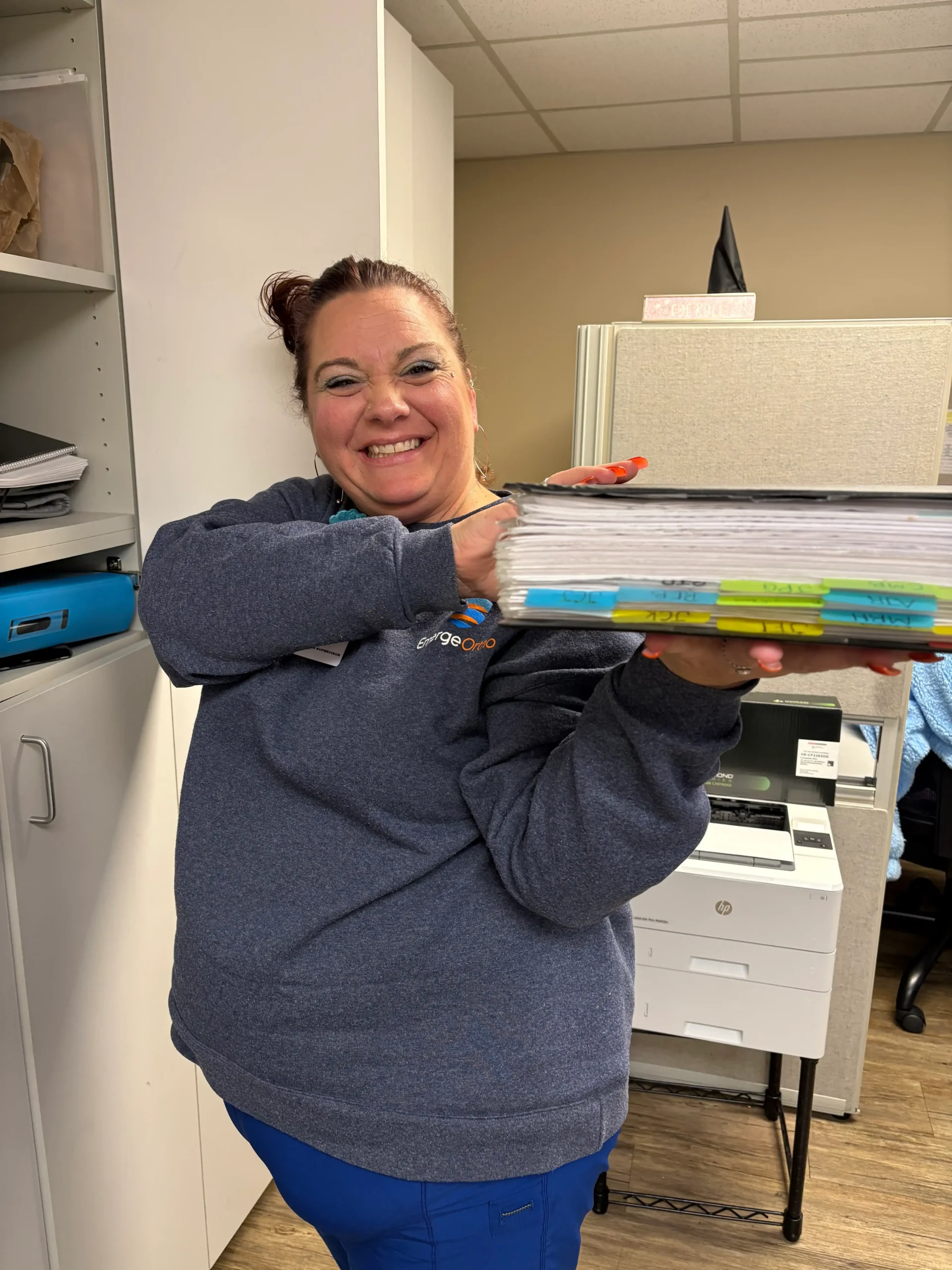
Printed training manuals/binders replaced by in-workflow guidance inside CareDesk.

Internal observations that training and new hire ramp time felt materially faster once guidance moved into the workflow.

BlueRidge is a qualitative vignette. Metrics and quotes are being verified and will be added once confirmed. This section does not imply the quantified outcomes shown for the EmergeOrtho organization-level case example or for any other client above.

What "Training Compression" Means

Training compression uses structured workflows to shorten the training period for new hires and reduce the time it takes for them to take calls independently. This helps employees become productive faster while maintaining the quality of their learning.

How CareDesk compresses training 

Keona Icon

Guided workflows

CareDesk handles scripting and helps with in-workflow decision support. It provides structured prompts that guide new hires' conversation during a call. This way, they don't have to memorize the process first. During a call, CareDesk analyzes the call context and suggests next steps based on patient responses. 

Keona Icon

Automation + rules


All scheduling requirements are consistently enforced because CareDesk applies the rules, while the new hire focuses on scheduling the appointment. New hires don't have to memorize complex scheduling guidelines before they can start working.

Keona Icon

Automatic documentation


CareDesk automatically records what happens on the call. Every interaction is documented, resulting in less after-call work. This reduces the burden on a new hire to manually enter the details of what happened on the call. They spend less time learning recordkeeping and can focus on the call. Also, the next person who interacts with the patient has a clear record of what already happened.

Want to know how your team can do the same?

The True Value of Training Compression 

Here’s how CareDesk adds financial value for our clients: 

Keona Icon

Labor leverage


Automating key parts of the onboarding process can reduce the number of weeks of shadowing and trainer hours per new hire. New hires do more work, freeing senior staff to focus on higher-value work. 

Keona Icon

Capacity recovery


A faster ramp reduces call backlogs and abandoned calls by allowing new hires to start answering calls sooner. Organizations can improve revenue by optimizing their agents' time, capturing more patient demand, and keeping the provider's schedule full. EmergeOrtho's jump from 11,000 to 25,000 calls without added phone staff is a direct illustration. 

Keona Icon

Consistency and rework


Most rework traces back to the same thing — a new hire without guidance in the moment, who had to guess. With CareDesk's scripting, new hires can remove the guesswork and get work done right the first time. Downstream rework is reduced. 

Keona Icon

What we will quantify in your demo


CareDesk can quantify the baseline training timeline, trainer hours, and ramp-to-independence. It can also measure the level of complexity a new hire carries before they're independent. From there, you can see exactly where CareDesk compresses the ramp and what that's worth to your practice. 

Ready to reduce training time and ramp faster?

We will map your workflows and show what training compression could look like for your team.

Posted By

Stephen Dean

Stephen Dean is COO of Keona Health, where he’s spent 13 years building AI systems that transform patient access. Before “agentic AI” was a term, his team was deploying autonomous systems that now handle millions of patient conversations annually.