
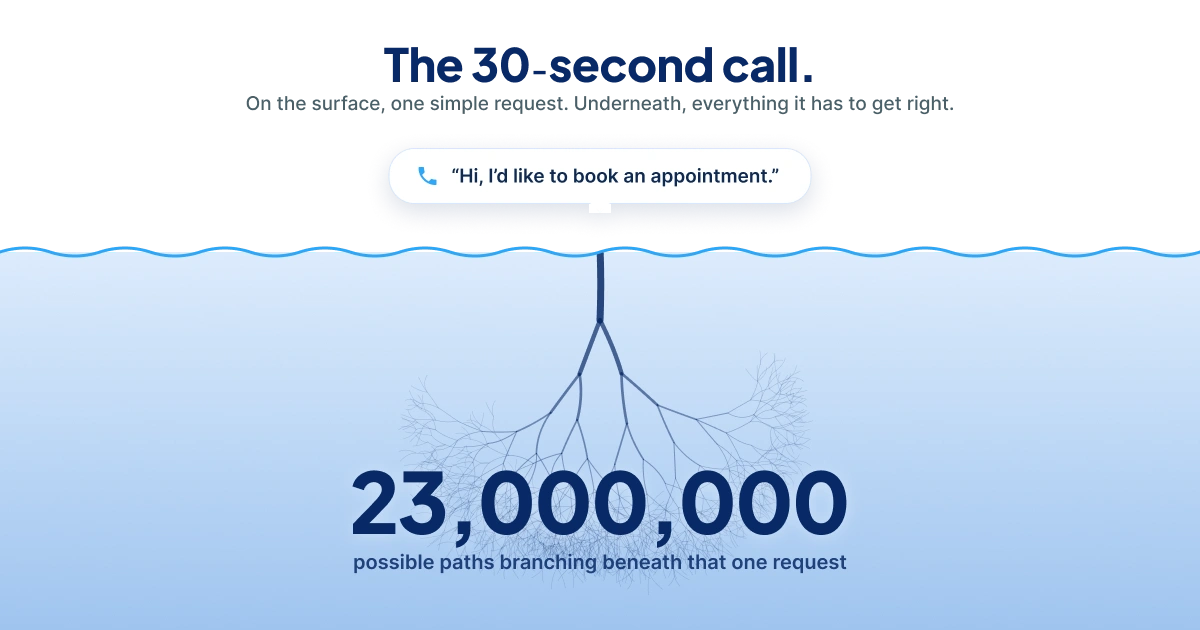
A patient calls to book an appointment. From the outside, nothing could be simpler: someone wants to be seen, your team finds a slot, the call ends. Thirty seconds of pleasant, forgettable work.
Underneath that thirty seconds sits a decision tree with more than 23 million possible paths.
That number isn’t a metaphor or a worst case. It’s an exact count from one real practice, Southeast Medical Group (SEMG), a multispecialty group that has begun presenting these numbers publicly. Every branch a caller could take, walked and counted. And SEMG is not an outlier. Over fourteen years we’ve run this same exhaustive path analysis across dozens of client practices of every size and shape, from small primary care clinics to single-specialty groups to large multispecialty systems. The specific counts differ from one to the next. The scale of the tree never does.
The count explains something the patient access industry has spent a decade trying not to say out loud: the reason “digital front doors” and “patient self-scheduling” keep underdelivering isn’t that practices implemented them badly. It’s that the work was never simple to begin with.
Here’s the part that matters most: the source of the complexity is your patients. Every one of them wants something a little different from the last, and that variety never goes away.
The math behind a "simple" call
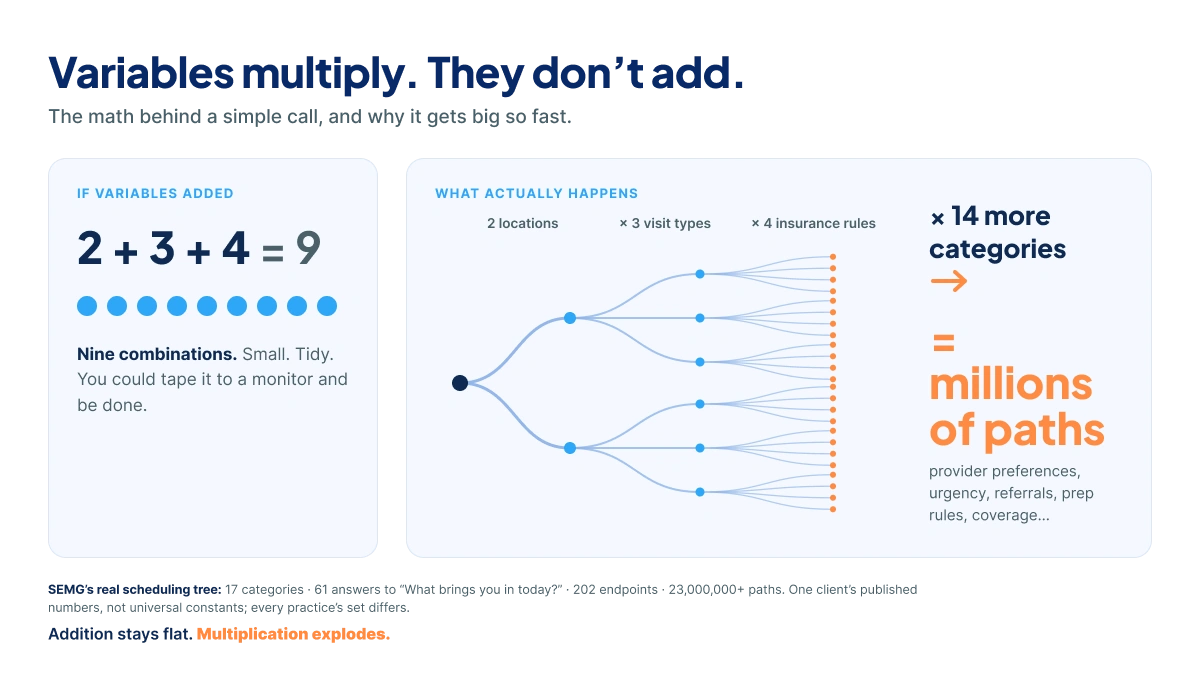
When that patient calls, the scheduler is quietly navigating seventeen categories of variables that don’t add together. They multiply.
Is the caller new or existing? That single fork gates everything downstream. What kind of appointment? An office visit, a pre-op, a workers’ comp claim, a DOT physical, a lab-only blood draw. If it’s an office visit, what’s the reason? Sixty-one distinct clinical complaints branch from that one question, from allergies to wound checks. Each complaint triggers its own set of rules.
Then layer in everything else: location, insurance type, age gates, referral and prior authorization requirements, vaccine and injection protocols, body part for injuries, procedure prep, EHR order prerequisites, provider certifications, controlled-substance rules, virtual-versus-in-person eligibility, and red-flag symptom screening. Seventeen variable categories in all. And because each one multiplies against the others rather than adding to them, a new Medicare Advantage patient needing an authorized stress test at one location is walking a completely different path than an existing patient calling for a flu shot at a location across town.
The whole tree resolves to 202 precisely defined scheduling outcomes: the right visit type, with the right provider, at the right location, with the right preparation. The single slot the patient is finally offered sits at the very end of that tree.
This is what your most experienced scheduler does in their head, on a good day, between sips of coffee. It’s impressive work. It’s also impossible to process appointments exactly the same way twice.
"But we're smaller than that"
The natural response to 23 million is: sure, but SEMG is a regional multispecialty group. We’re not that complicated.
It’s fair to assume that, but that assumption is the most important thing to get wrong about patient access. Complexity was never coming from SEMG’s size.
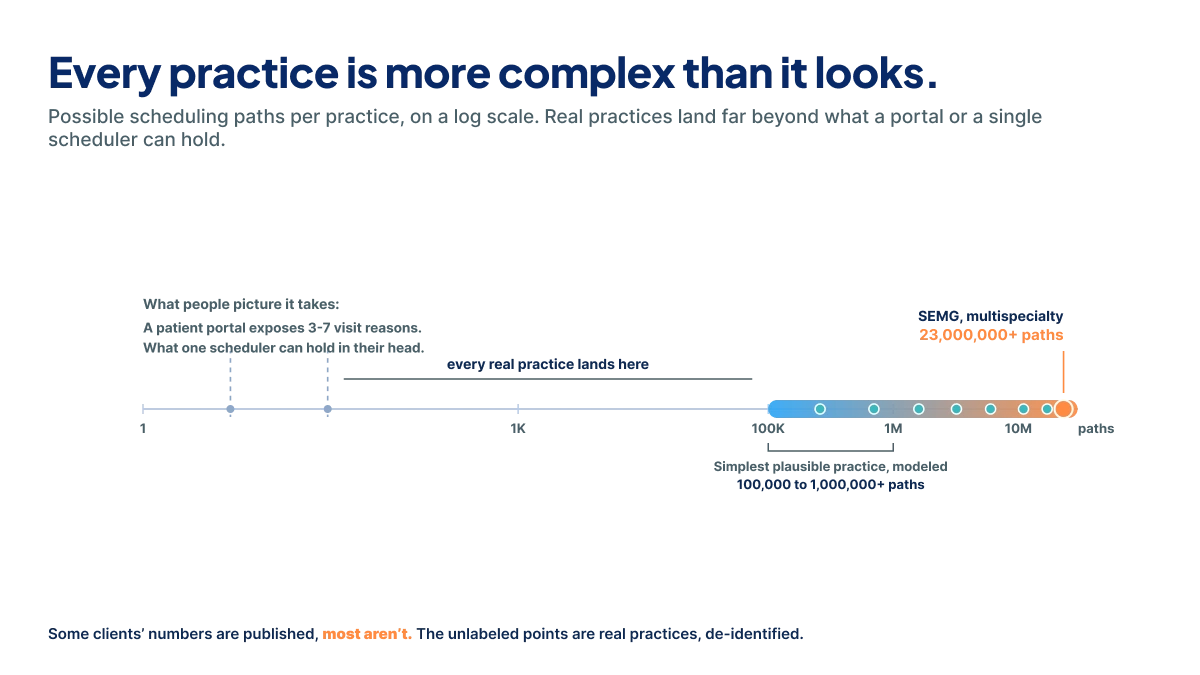
Here is what the cross-client analysis actually shows. The smallest practices we measure, down to a single-location primary care clinic with a handful of providers, still resolve to hundreds of thousands of possible paths. Single-specialty groups, with none of a multispecialty system’s sprawl, climb well into the millions, not far behind SEMG itself.
We can name SEMG because SEMG chose to make its numbers public. Most practices understandably keep the specifics private, and that changes nothing about the pattern. From primary care to single-specialty to multispecialty, every organization we analyze carries its own dense tree of paths, categories, branches, and endpoints.
Not one of them fits inside the handful of options a patient portal exposes, and not one is small enough for a single scheduler to hold in their head.
The math says this is exactly what we should expect. Take SEMG’s own tree and shrink it: drop from ten locations to two and you’re still somewhere between five and eight million paths; cut the appointment types down to a handful and you’re still in the millions; strip out vaccines entirely and you barely dent the tree.
Even the simplest plausible practice (two locations, five appointment types, no procedures) stays in the hundreds of thousands, and often well past a million, because the binary safety and eligibility questions branch relentlessly no matter how much else you remove.
So we can say it plainly: SEMG isn’t exotic. It’s typical. Complexity in patient access is not a function of how big you are. It’s a function of the fact that patients have different needs. That holds in a 2-provider office and a 200-provider system alike. One just has more of it.
Curious where your own operation sits on that curve? The Patient Service Maturity Model maps the climb from rules-in-people’s-heads to rules-in-software.
Why "self-service" keeps disappointing
Once you can see the size of the tree, a lot of your struggles to implement a satisfactory solution start to make sense.
You can’t hand a patient 23 million paths and call it self-scheduling. So most patient portals don’t. They expose a thin slice (typically three to seven visit reasons) and route everything else into “request an appointment and wait for a callback.” That isn’t self-service. It’s a contact form with extra steps, and patients can feel the difference.
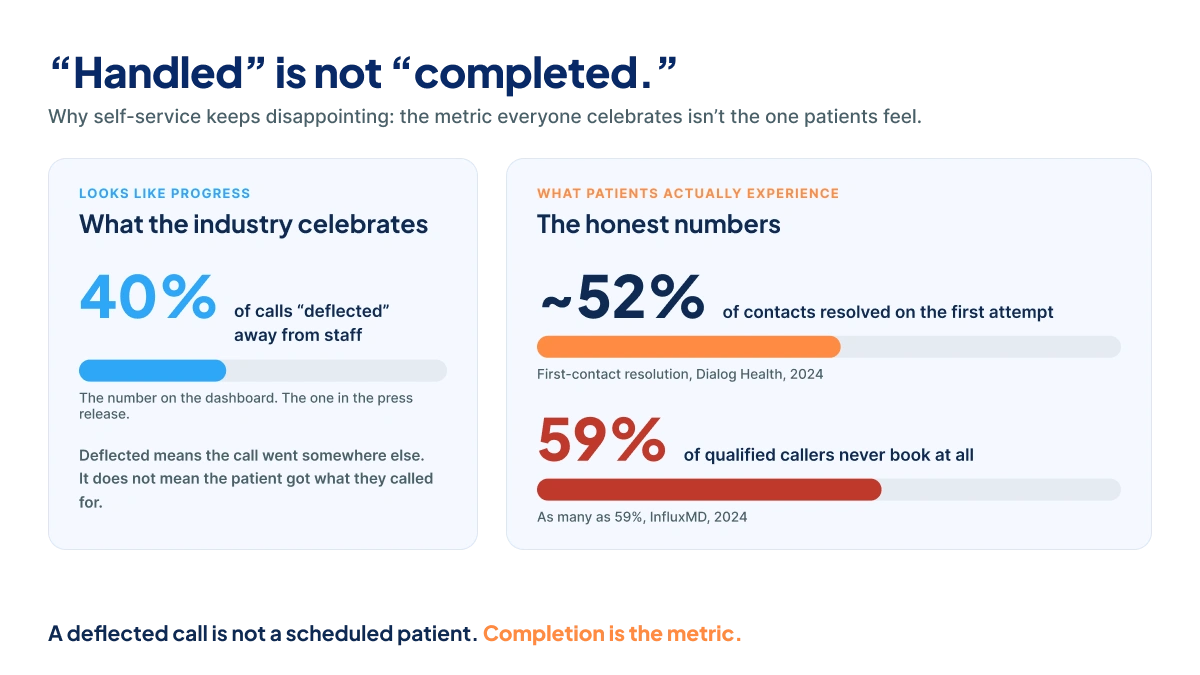
It’s also why “deflection” became the industry’s favorite metric, and why it quietly misleads. Deflecting 40% of calls sounds like progress until you remember that the other 60% still need help. A deflected call isn’t a completed request. Handling an interaction and actually getting the patient scheduled, screened, and prepared are different activities. The gap between them is where access breaks down: industry data puts first-contact resolution at roughly 52% (Dialog Health, 2024), and as many as 59% of qualified callers who reach a practice never end up booking at all (InfluxMD, 2024).
None of that is a technology failure. When you give complex work to tools, or to patients, without giving them the rules, you’ll get an incomplete solution.
Where the complexity actually lives
The fix everyone reaches for is the front door: a better website, a smarter chatbot, a slicker scheduling widget. But the front door was never the hard part.
The hard part lives behind it, in the logic almost nobody writes down. Which providers are certified for a DOT physical? Does this HMO plan need referral authorization before cardiology? What’s different if the EHR already has an active order for that stress test? Does the caller describing a stiff neck and a headache need a slot next week, or a nurse right now?
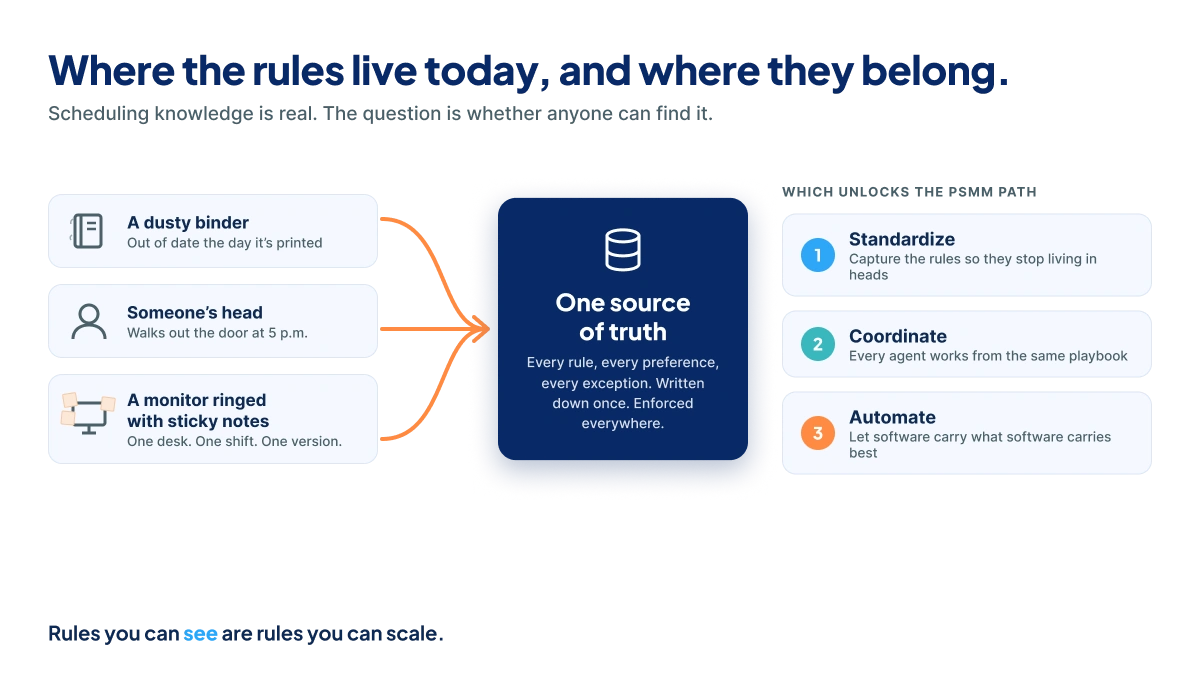
Today, in most practices, that logic lives in three places: training binders nobody has updated in a decade, the tribal knowledge in your most senior scheduler’s head, and a ring of sticky notes around a monitor. It works, right up until that scheduler is out, or a new hire takes the call, or it’s 7 p.m. and the office is closed. Then the same patient gets a different answer, and consistency (the very thing patient safety depends on) evaporates.
That last category, red-flag screening, is the one that should keep you up at night: a patient who ends up booking a routine visit when the symptoms warranted a same-day appointment. That at-risk patient never shows up in a deflection dashboard. They show up later, somewhere worse. Getting that right every time, regardless of who answers, isn’t a nicety layered on top of scheduling; it’s the whole job.
The only way through is to write and use the rules
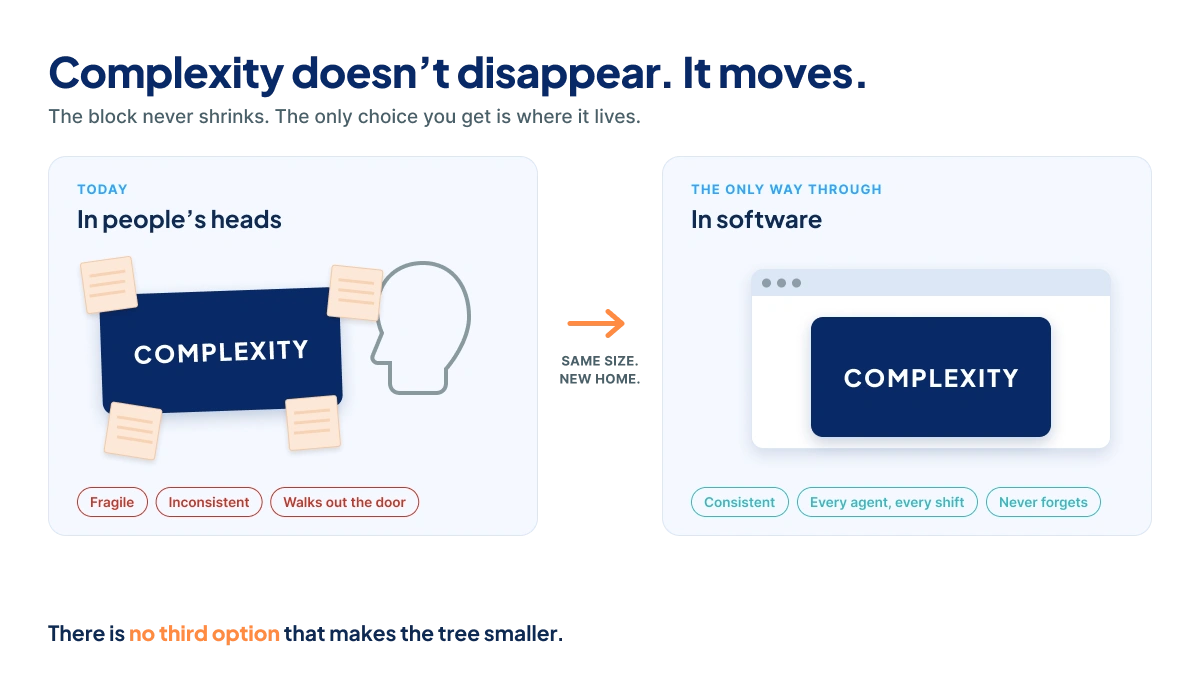
Here’s the part that sounds obvious the moment you say it and changes everything in practice: complexity doesn’t disappear. It can only move.
You can leave it in people’s heads, where it’s fragile and inconsistent, or you can encode it into software, where it runs the same way for every caller, every shift, every time. There is no third option that makes 23 million paths smaller.
But you can’t automate chaos. Before any of this can run on its own, the rules have to be made explicit: standardized, written down, validated. Which is why the practices that actually solve patient access tend to move through the same progression, one we’ve watched play out across hundreds of practices:
once the logic is explicit and connected, let software navigate the tree the same way every time.
This is the Patient Service Maturity Model, and the order is not optional. You can’t coordinate what you haven’t standardized, and you can’t safely automate what you haven’t coordinated. Most of the real work isn’t on the front door at all. It’s in these first steps, where the maze finally gets mapped.
What "encoded" looks like
Encoding the tree changes the call before anyone says a word. Eligibility, insurance, active EHR orders, and provider certifications all get checked automatically the moment the call connects. The two-dozen-plus questions a caller used to sit through are answered by the system before they’re asked. The decisions that used to mean putting a patient on hold to dig through a chart resolve silently. That is the work SEMG’s analysis represents: every branch identified, every rule written down, every path made navigable by software instead of memory.
You can see what it’s worth on the other side of that work. EmergeOrtho (North Carolina’s largest physician-owned orthopedic group, 270 providers across 45-plus locations) was drowning in exactly this complexity. They had call specialists who couldn’t keep provider protocols straight, appointments landing with the wrong doctors, critical patient details slipping between calls. Once the scheduling rules, provider requirements, and triage logic were encoded, they doubled patient visits over two years, without adding a single service-staff member, held 100% scheduling accuracy with provider complaints down to near zero, and cut new-coordinator onboarding from three weeks to under one.
The 23 million paths didn’t get smaller. EmergeOrtho just stopped asking people to memorize them.
That’s the whole reframe. The point was always completion: the right appointment, with the right preparation and the right safety check, delivered accurately and consistently, no matter who picked up the phone or what time it was.
Patient access feels hard because it is hard. There are millions of ways a single call can go, and only one of them is right for the patient on the line. The organizations that have successful patient access accept that the complexity is real and permanent, then encode it, once and carefully, so that every patient gets the version of your practice your best team member would have given them.