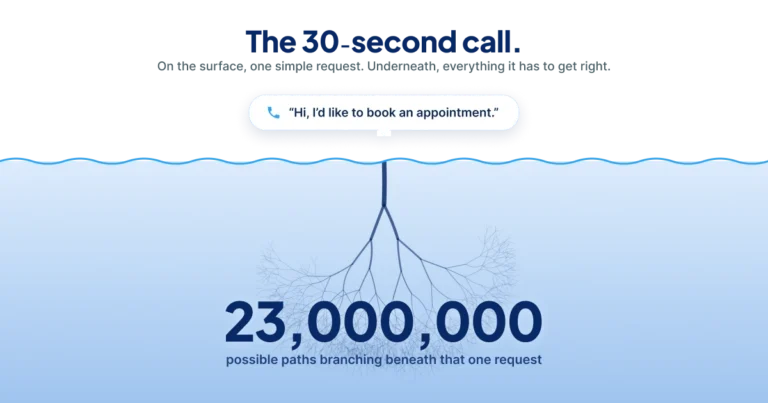


Most patients don’t announce that they’re done waiting. They just stop. In the exam room they’ll sit for a surprisingly long time, because leaving means rescheduling and they’re already there. On the phone, the same person hangs up in under two minutes and calls somebody else.
That’s the version of this question worth asking. Not how long patients tolerate a waiting room, but how long they stay on hold before they quietly become somebody else’s patient.
Two kinds of waiting, one kind of trust
A waiting room and a hold queue feel like different problems. One is a staffing and scheduling issue, the other is a phone issue, and they usually belong to different people internally.
To the patient they’re the same signal. Both say something about whether this practice has its act together, and both happen before anyone has delivered any care. A patient who waits 40 minutes past their appointment time and a patient who waits 6 minutes on hold have learned the same thing.
The difference is that you can see the person in the waiting room. The one on hold leaves no trace unless you go looking for it.
The wait you can’t see
Call abandonment is the measurement that captures this, and most practices underestimate it badly because the abandoned calls never become anything. There’s no message, no complaint, no rescheduled appointment. The line just clears.
What makes it expensive is who abandons. A patient calling to confirm an appointment they already have will wait, because they have a reason to. A new patient calling to find out whether you take their insurance has no such investment. They’ll give you a minute or two, then work down the list.
So the calls you lose skew toward the ones you most wanted, and the calls you keep skew toward the ones that were already yours.
Why “answer faster” isn’t the fix
The instinct is to attack hold time directly: more staff on phones, tighter scripts, a callback option. Those help, and they’re all bounded by the same ceiling. You’re still asking a patient to wait for a person to do something a person may not need to do.
A meaningful share of inbound volume is routine. Confirming an appointment. Moving one. Asking what to bring. Refill requests. None of that requires clinical judgment, and all of it consumes the same queue as the calls that do.
The structural fix is to stop generating the wait. When patients can self-schedule, and when an AI agent takes the repetitive calls, the queue that remains is shorter and the people in it are the ones who genuinely need a person. At mature deployments roughly 30% of appointments self-schedule, which is 30% of that volume never entering the queue at all.
CareDesk is built around that split. Kara is available to take repetitive calls autonomously, and anything requiring judgment transfers to staff with the full conversation attached, at a 95% handoff completion rate. The patient who does need a person gets one faster, because fewer people are ahead of them for no reason.
What to measure instead of hold time
Hold time is an input. These tell you what it’s costing:
- Abandonment rate, split by new versus existing patients. If new-patient abandonment is meaningfully higher, you’re losing acquisition, which costs more than convenience does.
- Time to abandonment. Where the curve drops tells you your actual tolerance window, which is almost always shorter than the one people assume.
- Share of calls that needed a person. If most didn’t, hold time is a symptom.
- Repeat calls for the same issue. A resolved call that comes back was not resolved.
The honest answer
There isn’t a universal number of minutes. Tolerance depends on why the patient called, whether they’re already yours, and what alternatives are one search away. Which is the uncomfortable part: your competitors set your acceptable hold time, and your staffing model just has to meet it.
What you can control is how many people have to wait at all.
See CareDesk run on your call volume. We will model the recovered appointments and reclaimed staff hours on your numbers.
Frequently asked questions
How long will patients wait on hold before hanging up?
It varies by why they called. Patients with an existing appointment tend to wait; new patients calling to ask a qualifying question tend to leave quickly, because they have alternatives and no investment yet.
Is waiting-room time or hold time worse for patient retention?
Hold time is more damaging in one specific way: the patient leaves without a trace. A long waiting-room wait is visible and recoverable. An abandoned call looks like nothing happened.
What is a good call abandonment rate for a medical practice?
Rather than chasing a benchmark number, compare abandonment for new versus existing patients. A gap between them tells you the wait is costing you acquisition, which is the expensive kind of loss.
How do you reduce patient hold times without hiring?
Remove calls from the queue instead of processing them faster. Self-scheduling and an AI agent handling routine requests shrink the queue, so the callers who need a person reach one sooner.
Does self-scheduling actually reduce call volume?
It moves routine booking out of the phone queue entirely. At mature deployments roughly 30% of appointments self-schedule, and those never become calls.