Request Demo

Kara: AI Voice Agent for Patient Access and Call Automation

When call volume spikes, what happens?

Patient demand isn’t uniform. It surges, and when it does, patient access breaks first.

Mornings. Mondays. Seasonal peaks.

Calls queue, patients hang up. Your staff moves faster, but accuracy drops and frustration builds for both patients and your team.

Handling patient demand shouldn’t have to depend on how quickly your team can react under pressure. With the right AI voice agent in place, it doesn’t.
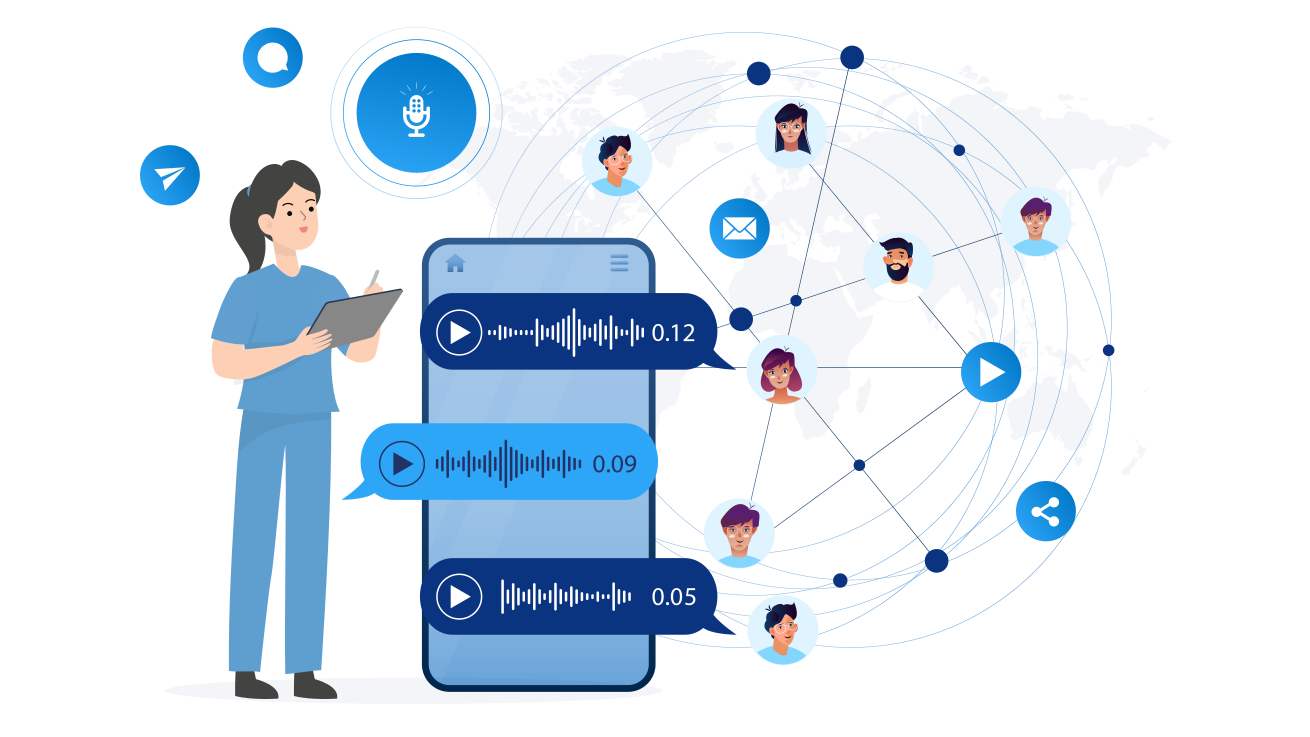

Kara_ AI Voice Agent for Patient Access and Call Automation

What Feels Impossible in Healthcare Access

Impossible in Healthcare Access

Answering every patient call immediately, without increasing your headcount or callbacks.

Completing routine requests end-to-end without pulling your staff away from more complex work.

What that means in practice:

For most healthcare organizations, this level of responsiveness feels out of reach. Access is constrained by staffing, and staffing has limits.

Why Patient Access Demand Breaks Most AI Voice Agent Systems

Most call handling systems treat every request the same.
In reality, patient access is shaped by a mix of volume, variability, and context.

Volume variability

Your call demand fluctuates throughout the day and week, but your staffing levels stay fixed.

Mixed complexity

Simple patient requests and complex coordination enter the same queue, competing for your team’s attention.

Fragmented context

Your staff moves between systems to understand the patient, the provider, and the request before taking action.

All-or-nothing automation

Standard AI voice agent systems either fully automate or fully escalate. When a request falls outside your predefined paths, it breaks.

Add these together, and the outcome is predictable. Your queues grow, your calls are abandoned, and your staff spend time on work that doesn’t require their expertise.

How Kara Makes Voice AI Work in Healthcare

Kara is built on CareDesk, a healthcare CRM shaped by over a decade of real-world workflows. It works by separating routine work from complex work, then handling each in the most efficient way possible.
How Kara Makes Voice AI Work in Healthcare

01

Dual-Engine Architecture

Kara uses a dual-engine model designed for healthcare environments. The Autopilot engine completes your routine requests end-to-end. The Copilot engine supports your staff when cases require human judgment. When calls become complex, they transition instead of failing.

02

Autopilot: Routine Requests, Fully Handled

Common patient requests are completed without staff involvement:

Each interaction follows your practice workflows, so outcomes stay consistent regardless of your call volume.

03

Copilot: Complex Cases, Resolved Faster

When a request requires coordination or judgment, Kara escalates it to your staff with context already assembled:

Your staff step into the conversation with the relevant information in front of them, reducing repetition and shortening resolution time.

04

360 Context Model

Both engines operate using a shared context layer designed specifically for healthcare.

Patient 360: Your patients’ history, prior interactions, and relevant context for the individual patient.

Provider 360: Your providers’ preferences, scheduling constraints, and clinical workflows.

Practice 360: Your practice’s operational rules, protocols, and site-specific requirements.

Decisions are made with full context, not partial information.

05

Workflow Impact

Routine work is removed from your staff queues. Complex work becomes easier to resolve because the groundwork is already done. Patient access improves without increasing your staff levels, and your team can focus their time where it adds the most value.

Proof of Patient Access in Practice

Kara is live and answering calls in medical practices and healthcare systems today, with more expanding every month. For organizations evaluating what this approach can deliver at scale, CareDesk’s proven performance provides a clear reference point:

These outcomes reflect what happens when AI voice is built on structured, context-driven systems.

What to Expect

Getting started follows a structured path designed around your existing workflows.

Workflow demo

Map your highest-volume call types and simulate how they are handled using your practice’s rules.

Step 1

Custom ROI model

Estimate Kara’s impact on your practice based on your call volume, abandonment rates, and visit revenue.

Step 2

Pilot

Launch your focused pilot, typically within 4 to 6 weeks, with measurable results within the first 60 days.

Step 3

FAQs AI Voice Agent

What is an AI voice agent in healthcare?

Kara is an AI voice agent built specifically for healthcare, designed to answer patient calls and complete routine requests such as scheduling or cancellations while following real clinical and operational workflows.

Unlike systems that simply route calls and create rework, Kara completes routine requests end-to-end and escalates complex cases with context, reducing the volume of calls that reaches your staff, and improving how work is handled.

As an AI voice agent, Kara handles high-volume requests such as scheduling, cancellations, prescription refills, and general inquiries, completing these interactions consistently without requiring staff to be involved in each call.

When a request requires coordination or judgment, Kara escalates the call to staff with full context, allowing the team to continue seamlessly rather than restarting the conversation from the beginning.

Kara is the AI voice agent built on CareDesk workflows, using structured rules and real operational context to deliver consistent outcomes for routine requests while ensuring complex cases are escalated to staff with full context.

Kara integrates with the existing healthcare systems, allowing the AI voice agent to access patient information, apply scheduling rules, and complete requests within your current workflows, instead of creating additional systems to manage.

Patients interacting with Kara experience immediate responses and faster resolution, which often leads to greater satisfaction compared to waiting on hold for routine requests.

Kara improves patient access by answering calls instantly, completing routine requests without delay, and reducing pressure on staff, ensuring patients receive timely responses regardless of call volume.

Kara is designed as a healthcare AI voice agent with secure data handling, controlled access, and auditable interactions, supporting compliance requirements such as HIPAA within patient access workflows.

Unlike large IT switchover projects, Kara can be deployed as an AI voice agent within a few weeks. Many organizations elect for a focused pilot, allowing them to measure impact on call handling and patient access before expanding further.

Model the Impact on Your Call Center & Patient Access Operations

Healthcare organizations that implement healthcare-native AI voice technology are managing increased patient call volume without hiring more staff.

Find out why Kara, built on CareDesk, is more than an AI voice agent.

Our team can help you model the care completion, scheduling accuracy, and workflow impact that Kara can have for your organization.

Why Active Patient Engagement Seems Impossible?

Visit types differ in duration and preparation.

Insurance requirements affect treatment authorization.

Provider preferences vary.

Locations operate with different capacity constraints.

Treatment sequencing must align with diagnosis and care plans.

Most online tools simplify these processes to protect against error.

But oversimplification creates new problems: callbacks increase, care teams manually correct bookings, and patients receive conflicting information.

Without synchronized healthcare data and true scheduling intelligence, self-service breaks and staff end up fixing what patients started.

That is why many healthcare providers limit what patients can book online.

Complexity remains hidden and staff absorb the workload.

Why Specialty Scheduling Breaks Most Systems?

Most scheduling software treats appointments as interchangeable time slots. In reality, each booking depends on interacting constraints:

Provider-specific rules

Each clinician uses different visit types, durations, equipment, and scheduling preferences.

Insurance and pre-authorization workflows

Eligibility, referrals, and payer requirements must be verified before booking.

Surgical coordination constraints

Hours, staffing, and resources vary across sites.

Surgical coordination constraints

Imaging, procedures, and follow ups depend on each other.

Add staff turnover and long onboarding cycles, and the result is predictable:

Knowledge becomes tribal.

Training becomes lengthy.

Errors become normalized.

Provider trust declines.

This is a system limitation, not a staff failing.

Why Complexity Breaks Most Nurse Triage Software

Linear triage software

Static scripts for each isolated symptom.

Evaluates symptoms independently.

Provides the same recommendation in every situation.

Standardizes language only.

Clinical reality

Dynamic adjustment needed based on age, medications, pregnancy status and comorbidities.

Interaction between co-presenting symptoms changes risk and triage status.

The right decision depends on full context, location, time, staffing, and available resources.

Also needs consistent escalation decisions, documentation, and clinical reasoning.

Proof of Healthcare Access

At Golden State Orthopedic, scheduling process complexity had led to persistent errors, provider frustration, and low patient satisfaction.

Measured over 60 days after implementing CareDesk Elevate, compared to baseline:

100%

Scheduling accuracy reached.

0%

Provider complaints related to booking dropped to zero.

75%

Training time was reduced.

Days

Onboarding cycles shortened.

"Never, in all my days, have I heard of agents being trained and taking calls without error in 2 days of being hired."

Jordan Sappington

Golden State Orthopedic

CareDesk Elevate operates as part of your healthcare CRM system, so when a patient calls, self-schedules, or follows up, the full context is already in place.

Explore more real-world outcomes: